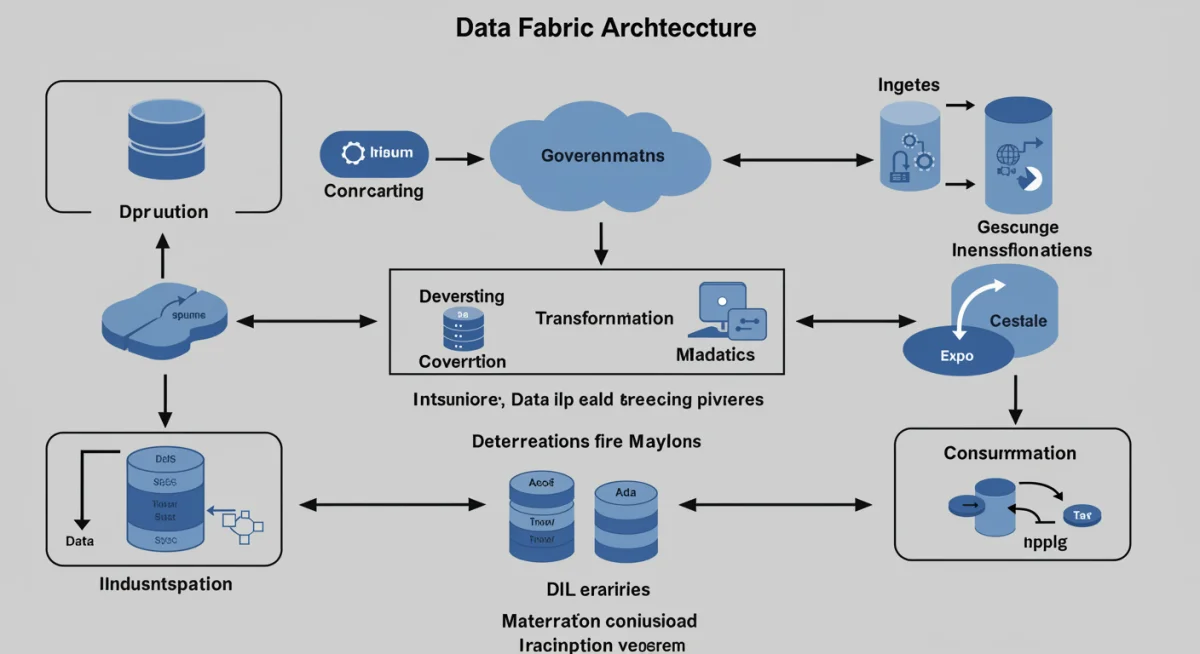
Data Fabric Architecture 2026: Unify Data, Boost Decisions
Data fabric architecture in 2026 offers US enterprises a strategic framework to unify disparate data sources, improve data governance, and enhance decision-making by an estimated 22%, driving significant competitive advantages.
Implementing a robust data fabric architecture enables US enterprises to seamlessly integrate and manage disparate data sources, leading to a projected 22% improvement in decision-making by 2026 through enhanced data accessibility and insights.
In today’s rapidly evolving digital landscape, US enterprises face an unprecedented challenge: managing an explosion of data scattered across countless systems. This complexity often hinders agile decision-making and innovation. Enter data fabric architecture, a revolutionary approach poised to transform how organizations interact with their data by 2026, promising to unify disparate data sources and significantly improve decision-making.
Understanding the data fabric architecture paradigm
The concept of data fabric architecture represents a fundamental shift from traditional, often fragmented data management approaches. Instead of creating point-to-point integrations for every new data need, a data fabric provides an integrated, intelligent, and automated platform for accessing, discovering, preparing, and governing data across hybrid and multi-cloud environments. It’s not a single product but an architectural style that delivers a unified view of an enterprise’s data landscape.
This architectural paradigm focuses on abstracting the underlying complexity of data sources and locations, offering a consistent experience for data consumers, whether they are applications, analytics tools, or human users. By leveraging metadata, AI, and machine learning, data fabric automates many data management tasks that were once manual and time-consuming.
Key principles of data fabric
At its core, data fabric is built upon several foundational principles that drive its effectiveness and transformative potential:
Unified data access: Provides a single point of access to data regardless of its physical location or format.
Intelligent data integration: Employs AI and ML to automate data discovery, profiling, and integration across diverse systems.
End-to-end data governance: Ensures consistent security, privacy, and compliance policies are applied across all data.
Self-service data consumption: Empowers business users with easy access to trusted data for analysis and decision-making.
These principles work in concert to break down data silos, reduce operational complexities, and accelerate time-to-insight. For US enterprises striving for agility and data-driven innovation, understanding these tenets is the first step toward successful adoption.
In essence, data fabric architecture serves as an organizational nervous system for data, enabling it to flow freely and intelligently to where it’s needed most. It moves beyond mere data warehousing or data lakes by providing a dynamic, adaptable framework that learns and evolves with the business’s data needs. This holistic approach ensures that data is not just stored, but actively managed and utilized as a strategic asset.
The imperative for US enterprises: why 2026 is critical
The year 2026 marks a pivotal moment for US enterprises considering a data fabric. The proliferation of data, driven by IoT, AI, and digital transformation initiatives, has reached a point where traditional data management strategies are simply insufficient. Businesses are generating petabytes of data daily, residing in on-premise systems, various cloud platforms, and edge devices. Without a coherent strategy to manage this data deluge, organizations risk being overwhelmed, missing critical insights, and falling behind competitors.
Moreover, regulatory compliance, such as CCPA and evolving data privacy laws, places immense pressure on enterprises to have a clear, auditable view of their data. A data fabric architecture provides the necessary infrastructure to meet these demands, offering robust data governance and lineage capabilities. The competitive landscape in the US market is intensifying, with data-driven companies consistently outperforming their peers. Gaining a 22% improvement in decision-making is not just an aspiration; it’s becoming a business imperative.
Evolving data challenges and opportunities
The increasing complexity of data environments presents both challenges and unparalleled opportunities. Enterprises grapple with:
Data silos: Fragmented data across departments and systems.
Data quality issues: Inconsistent, incomplete, or inaccurate data impeding analysis.
Slow data access: Delays in getting relevant data to decision-makers.
Regulatory burden: Strict compliance requirements for data privacy and security.
A data fabric directly addresses these pain points, transforming them into opportunities for innovation and efficiency. By automating data integration and governance, it frees up valuable resources, allowing data scientists and analysts to focus on extracting value rather than wrangling data. The ability to quickly adapt to new data sources and analytical demands is a significant competitive advantage.
The urgency for US enterprises to adopt a more sophisticated data strategy by 2026 stems from these converging factors. The market is increasingly unforgiving of businesses that cannot leverage their data effectively. Data fabric offers a forward-looking solution that not only solves current problems but also positions organizations for future growth and resilience in a data-centric world.
Core components of a robust data fabric architecture
A successful data fabric architecture is not a monolithic solution but rather an intricate orchestration of several interdependent components working in harmony. These components ensure that data is not only accessible but also trustworthy, secure, and valuable across the enterprise. Understanding each piece is crucial for effective implementation and maximizing the benefits.
At its heart, a data fabric relies on advanced metadata management, which acts as the intelligence layer, providing context and meaning to all data assets. This metadata is continuously enriched through automated discovery and human input, forming a comprehensive knowledge graph of the organization’s data. This knowledge graph is what enables intelligent automation and self-service capabilities.
Essential elements for effective data unification
To truly unify disparate data sources, a data fabric incorporates several critical elements:
Data integration and ingestion: Tools and processes for connecting to diverse data sources, extracting, transforming, and loading data into the fabric. This includes real-time streaming, batch processing, and API-driven integrations.
Data transformation and enrichment: Capabilities to clean, standardize, and enhance data, ensuring it is fit for purpose. This often involves machine learning to automate data quality checks and suggest transformations.
Data governance and security: Policies, tools, and processes to manage data access, privacy, compliance, and lineage. This ensures data integrity and adherence to regulatory requirements across the entire data lifecycle.
Data catalog and discovery: A centralized repository of metadata that allows users to easily find, understand, and trust data assets. AI-powered search and recommendation engines are vital here.
Data delivery and consumption: Mechanisms for delivering data to various consumers, including APIs, data virtualization, data lakes, and data warehouses, optimizing for different analytical and operational needs.
Each of these components plays a vital role in building a cohesive and efficient data ecosystem. The seamless interaction between them is what differentiates a true data fabric from a collection of disparate data tools. For US enterprises, investing in a comprehensive platform that integrates these elements is paramount for achieving a unified data strategy.
Ultimately, the strength of a data fabric lies in its ability to abstract away complexity, providing a simpler, more intuitive experience for data users. By combining these core components, enterprises can move beyond merely collecting data to actively leveraging it as a strategic asset for innovation and competitive advantage.
Integrating AI and machine learning for enhanced decision-making
The promise of a 22% improvement in decision-making by 2026 through data fabric architecture is heavily reliant on the intelligent integration of AI and machine learning (ML). These technologies are not just add-ons; they are intrinsic to the fabric’s ability to automate, optimize, and derive deeper insights from vast and varied datasets. AI and ML transform raw data into actionable intelligence, making the data fabric a truly ‘smart’ system.
AI algorithms, embedded within the data fabric, can autonomously discover new data sources, profile their content, and even suggest optimal ways to integrate them. This automation drastically reduces the manual effort typically associated with data preparation and integration, accelerating the time it takes to get data ready for analysis. Machine learning models can also continuously monitor data quality, identify anomalies, and predict potential issues before they impact decision-making.
AI-driven capabilities within data fabric
The symbiotic relationship between AI/ML and data fabric architecture manifests in several powerful capabilities:
Automated data discovery and classification: AI agents scan and map data assets, automatically classifying them based on content, context, and sensitivity, enriching the data catalog.
Intelligent data quality: ML models learn expected data patterns, identifying and suggesting corrections for inconsistencies, errors, and missing values in real-time.
Smart data integration suggestions: AI proposes optimal integration patterns and transformations, reducing the need for manual coding and accelerating data pipeline development.
Personalized data recommendations: Based on user roles and previous queries, the data fabric can recommend relevant datasets and analytical tools to streamline data consumption.
Predictive analytics and anomaly detection: ML models can be deployed directly within the fabric to perform advanced analytics, providing predictive insights and flagging unusual data behaviors that require attention.
These AI-driven features empower US enterprises to move from reactive data management to proactive data intelligence. Decision-makers receive not just data, but curated, high-quality, and contextually rich information, often with predictive insights, enabling more informed and timely strategic choices. This intelligent layer is what truly elevates data fabric beyond traditional data platforms.
By leveraging AI and ML, data fabric architecture ensures that data is not merely collected and stored, but actively utilized to generate value. This intelligent automation is critical for US enterprises seeking to maintain a competitive edge and make data-driven decisions at the speed of business in 2026 and beyond.
Strategic implementation for US enterprises: best practices
Implementing a data fabric architecture is a significant undertaking that requires careful planning and execution. For US enterprises, a strategic approach is essential to ensure a smooth transition and maximize the return on investment. It’s not just about adopting new technology; it’s about transforming an organization’s relationship with its data. Rushing into implementation without a clear roadmap can lead to costly inefficiencies and failure to achieve desired outcomes.
A crucial first step involves a thorough assessment of the existing data landscape. This includes identifying all data sources, understanding existing integration challenges, and evaluating current data governance practices. This assessment forms the baseline against which the success of the data fabric implementation will be measured. Engaging key stakeholders from IT, business units, and data governance teams early in the process is also vital for alignment and buy-in.
Key considerations for a successful rollout
To navigate the complexities of data fabric implementation, consider these best practices:
Start small, think big: Begin with a pilot project focused on a specific business problem or data domain. This allows for learning and refinement before scaling across the enterprise.
Prioritize data governance: Establish clear data ownership, quality standards, and security policies from the outset. Data governance is the backbone of a trustworthy data fabric.
Invest in skill development: Train existing staff or hire new talent with expertise in data engineering, AI/ML, and data governance to manage and leverage the new architecture.
Adopt an agile methodology: Implement the data fabric incrementally, allowing for continuous feedback and adaptation to evolving business needs and technological advancements.
Focus on business value: Ensure every stage of implementation is tied back to specific business objectives, demonstrating tangible benefits and fostering ongoing support.
Successful implementation of a data fabric is a journey, not a destination. It requires continuous refinement and adaptation. For US enterprises, a phased approach, starting with critical business domains, allows for building confidence and demonstrating value early on. This iterative process helps in establishing a robust, scalable, and adaptable data fabric that truly serves the organization’s strategic goals.
By adhering to these strategic implementation best practices, US enterprises can effectively deploy a data fabric architecture that not only unifies their data but also transforms their ability to make informed, impactful decisions, driving significant business growth and innovation by 2026.
Overcoming challenges and ensuring adoption
While the benefits of data fabric architecture are compelling, the journey to full adoption is not without its hurdles. US enterprises will encounter various challenges, from technical complexities to organizational resistance. Successfully navigating these obstacles requires a proactive approach, clear communication, and a strong commitment from leadership. Ignoring these challenges can undermine even the most well-planned implementations.
One of the primary challenges is cultural resistance. Employees accustomed to traditional data silos may be hesitant to embrace new ways of working and sharing data. Overcoming this requires comprehensive change management initiatives, including clear communication about the benefits, extensive training, and demonstrating quick wins to build momentum and trust in the new system. It’s crucial to highlight how a data fabric empowers individuals and teams, rather than threatening their existing roles.
Common hurdles and mitigation strategies
Enterprises often face specific challenges during data fabric implementation:
Legacy system integration: Connecting the data fabric to older, disparate systems can be complex. Mitigation involves using robust integration tools and potentially modernizing critical legacy components.
Data quality and consistency: Initial data quality issues can hinder trust in the new system. A strong data governance framework and automated data quality tools are essential from the start.
Skill gap: A shortage of skilled professionals in data engineering, AI, and data governance. Mitigation includes investing in internal training, upskilling programs, and strategic hiring.
Security and compliance concerns: Ensuring data security and regulatory compliance across a unified fabric. Mitigation involves implementing comprehensive security protocols, access controls, and continuous auditing.
Measuring ROI: Demonstrating the tangible return on investment can be difficult in the early stages. Mitigation requires defining clear KPIs and regularly reporting on business value achieved through improved decision-making and efficiency.
Effective change management, coupled with a focus on demonstrating tangible business value, is paramount for ensuring widespread adoption. By addressing these challenges head-on, US enterprises can transform their data landscape and foster a truly data-driven culture. This requires not just technological solutions but also a shift in organizational mindset, promoting collaboration and data literacy across all departments.
Ultimately, overcoming these challenges leads to a more resilient, agile, and intelligent enterprise. A successful data fabric adoption means that by 2026, US businesses can truly leverage their data assets to innovate faster, serve customers better, and make decisions with unprecedented accuracy and speed, achieving that crucial 22% improvement in decision-making.
Measuring impact: achieving a 22% improvement in decision-making
The ultimate goal of implementing a data fabric architecture for US enterprises is to significantly enhance decision-making capabilities, with a target of a 22% improvement by 2026. Measuring this impact is crucial for validating the investment, demonstrating return on investment (ROI), and continuously optimizing the data fabric. This is not a vague aspiration but a quantifiable objective that requires careful planning, definition of key performance indicators (KPIs), and consistent monitoring.
Improved decision-making manifests in various ways, including faster market response times, more accurate forecasting, better resource allocation, enhanced customer experiences, and optimized operational efficiency. Each of these areas can be linked to specific metrics that allow enterprises to track progress and quantify the impact of their data fabric investment. The ability to access, analyze, and act on high-quality, unified data directly contributes to these improvements.
Quantifying the value of data fabric
To measure the 22% improvement, US enterprises should focus on a combination of quantitative and qualitative metrics:
Reduced time-to-insight: Track the time it takes from data ingestion to actionable insights. A data fabric should significantly shorten this cycle.
Accuracy of forecasts and predictions: Measure the improvement in the accuracy of business forecasts, sales predictions, and risk assessments due to better data.
Operational efficiency gains: Quantify cost reductions and process optimizations achieved through data-driven automation and improved resource allocation.
Customer satisfaction and retention: Monitor improvements in customer experience metrics, personalized offerings, and reduced churn rates resulting from better customer data analysis.
Innovation acceleration: Assess the speed at which new products, services, or business models are developed and launched, enabled by readily available and integrated data.
Beyond these direct metrics, qualitative improvements such as increased trust in data, enhanced collaboration across departments, and a more data-literate workforce also contribute to overall decision-making quality. Regular feedback loops with business users are essential to understand the real-world impact of the data fabric on their daily decision processes.
By meticulously tracking these indicators, US enterprises can not only confirm the achievement of their 22% improvement target but also identify areas for further optimization. This continuous measurement and feedback loop ensure that the data fabric remains a dynamic and highly valuable asset, evolving to meet the strategic needs of the business and consistently driving superior outcomes.
Key Aspect
Brief Description
Unified Data Access
Provides a consistent, single point of access to all enterprise data, regardless of location or format.
AI/ML Integration
Automates data discovery, quality, integration, and provides advanced analytics for deeper insights.
Enhanced Decision-Making
Aims for a 22% improvement in decision quality and speed by 2026 through data-driven insights.
Strategic Implementation
Requires careful planning, pilot projects, strong governance, and continuous skill development for success.
Frequently asked questions about data fabric architecture
What exactly is data fabric architecture?▼
Data fabric architecture is an intelligent, integrated data management platform that provides a unified, virtual view of an organization’s disparate data sources. It uses AI and machine learning to automate data discovery, integration, governance, and consumption across hybrid and multi-cloud environments, breaking down silos and improving data accessibility for better decision-making.
How does data fabric differ from a data lake or data warehouse?▼
While data lakes and data warehouses are storage solutions, a data fabric is an architectural approach that layers intelligence over existing data infrastructures. It doesn’t replace them but rather integrates and governs data across all these sources, providing a holistic view. A data fabric focuses on data access, integration, and governance, not just storage.
What benefits can US enterprises expect from implementing data fabric by 2026?▼
US enterprises can expect significant benefits, including a projected 22% improvement in decision-making through enhanced data insights, faster time-to-market for data products, improved data governance and compliance, reduced operational costs for data management, and increased agility in responding to market changes. It fosters a truly data-driven culture.
What are the main challenges in adopting data fabric architecture?▼
Key challenges include integrating with complex legacy systems, ensuring high data quality across diverse sources, addressing skill gaps within the workforce, managing security and regulatory compliance across a unified system, and demonstrating clear return on investment. Effective change management and pilot projects are crucial for success.
How does AI and machine learning enhance data fabric functionality?▼
AI and ML are integral to data fabric, automating tasks like data discovery, classification, and quality checks. They provide intelligent integration suggestions, personalize data recommendations, and enable advanced predictive analytics directly within the fabric. This intelligence dramatically reduces manual effort and accelerates the generation of actionable insights.
Conclusion
The journey towards a truly data-driven enterprise in the US is increasingly reliant on sophisticated architectural solutions, with data fabric architecture emerging as a frontrunner. By 2026, its ability to unify disparate data sources, leverage AI and machine learning for intelligent automation, and enforce robust governance will be non-negotiable for competitive advantage. The promise of a 22% improvement in decision-making is not merely an ambitious target but a tangible outcome for organizations committed to strategic implementation and overcoming inherent challenges. As data continues to grow in volume and complexity, the data fabric offers a resilient, adaptable, and intelligent framework, empowering US enterprises to transform raw data into their most valuable strategic asset, driving innovation and sustainable growth in the years to come.