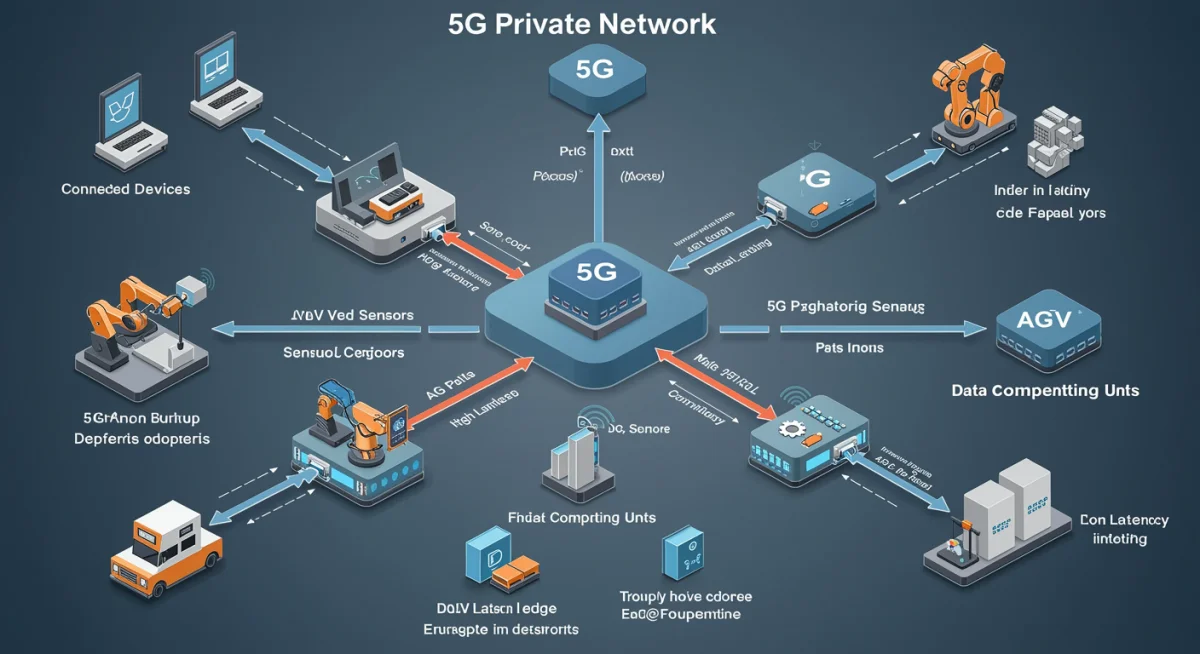
Implementing 5G Private Networks in US Manufacturing: A Guide to 99.99% Uptime
This guide outlines the critical steps for US manufacturing facilities to implement 5G private networks, targeting an ambitious 99.99% uptime by early 2026. It covers planning, deployment, optimization, and security, essential for driving industrial innovation and operational efficiency.
Achieving 99.99% uptime in US manufacturing by early 2026 hinges on the strategic implementation of 5G private networks, providing unparalleled reliability, low latency, and enhanced security for industrial operations.
The landscape of US manufacturing is undergoing a profound transformation, driven by the relentless pursuit of efficiency, automation, and resilience. At the heart of this revolution lies the potential of 5G private networks manufacturing, a technology poised to redefine operational paradigms. This comprehensive guide delves into the essential steps for manufacturers to successfully implement 5G private networks, aiming for an ambitious 99.99% uptime by early 2026.
Understanding the Foundation: What are 5G Private Networks?
Before embarking on any implementation journey, it’s crucial to grasp the fundamental concepts behind 5G private networks. These are not merely an extension of public cellular networks; rather, they are dedicated, localized networks designed to meet the specific demands of an enterprise. They offer unparalleled control, security, and performance, making them ideal for mission-critical industrial applications.
Unlike public 5G, which shares resources across numerous users, a private 5G network dedicates its spectrum and infrastructure to a single entity. This exclusivity translates into guaranteed quality of service, predictable latency, and enhanced data privacy. For manufacturing, where every millisecond and every data packet counts, these characteristics are not just advantageous but often essential for advanced capabilities.
Key Characteristics of Private 5G
Dedicated Spectrum: Manufacturers can acquire or lease dedicated spectrum, ensuring interference-free operation and consistent performance.
Enhanced Security: Data remains entirely within the enterprise’s control, reducing exposure to external threats and complying with stringent regulatory requirements.
Ultra-Low Latency: Critical for real-time control of robotics, autonomous guided vehicles (AGVs), and other time-sensitive processes.
High Bandwidth: Supports the massive data streams generated by IoT sensors, high-definition video surveillance, and augmented reality (AR) applications.
Customization and Control: The network can be tailored precisely to the specific needs of the manufacturing operation, from coverage areas to device prioritization.
In essence, a private 5G network acts as a robust, secure, and highly reliable nervous system for the modern factory, enabling a new era of digital manufacturing. Understanding these core tenets is the first step toward harnessing its transformative power for achieving ambitious uptime goals.
Phase 1: Strategic Planning and Assessment
The journey to 99.99% uptime begins long before any equipment is deployed. Strategic planning and a thorough assessment of current and future operational needs are paramount. This initial phase lays the groundwork for a successful implementation, ensuring that the 5G private network aligns perfectly with the manufacturing facility’s objectives and infrastructure.
It involves a detailed analysis of existing connectivity solutions, identifying pain points such as unreliable Wi-Fi, limited bandwidth, or security vulnerabilities. Manufacturers must also project their future requirements, considering the adoption of new technologies like AI-powered quality control, predictive maintenance, and fully autonomous production lines. This foresight prevents costly reconfigurations down the line.
Defining Operational Requirements
Clearly articulating what the 5G private network needs to achieve is critical. This includes defining specific performance metrics, such as required latency for critical applications, bandwidth for data-intensive processes, and the number of devices to be connected. These requirements will guide the selection of hardware, software, and network architecture.
Identify Critical Applications: Pinpoint which manufacturing processes will benefit most from 5G, such as real-time machine control, AGV navigation, or remote monitoring.
Map Coverage Areas: Determine the precise physical areas within the facility that require 5G connectivity, including production floors, warehouses, and outdoor spaces.
Assess Device Density: Estimate the number of IoT sensors, robots, handheld devices, and other endpoints that will connect to the network.
Evaluate Security Needs: Define the level of data encryption, access control, and network segmentation required to protect sensitive operational data.
By meticulously planning and assessing these factors, manufacturers can create a robust blueprint for their 5G private network, ensuring it is purpose-built to deliver the desired uptime and operational excellence.
Phase 2: Vendor Selection and Network Design
With a clear understanding of operational requirements, the next step involves selecting the right technology partners and designing the network architecture. This phase is crucial for ensuring the chosen solution is scalable, secure, and capable of meeting the stringent demands of modern manufacturing.
The market for 5G private network solutions is diverse, with various vendors offering different approaches, from end-to-end solutions to modular components. Manufacturers must carefully evaluate potential partners based on their expertise, track record in industrial deployments, and the flexibility of their offerings. A strong partnership with a vendor who understands manufacturing nuances can significantly streamline the implementation process.
Designing the Network Architecture
The network design process is highly technical and requires specialized expertise. It involves decisions about spectrum allocation, core network deployment (on-premise or hybrid cloud), radio access network (RAN) configuration, and integration with existing IT and operational technology (OT) systems. Edge computing, which brings data processing closer to the source, is a critical component for achieving ultra-low latency in manufacturing.
Spectrum Acquisition: Secure appropriate spectrum, whether licensed, unlicensed (CBRS in the US), or shared.
Core Network Deployment: Decide between a fully on-premise core for maximum control or a hybrid approach leveraging cloud resources.
RAN Planning: Determine the optimal placement of small cells and antennas to ensure seamless coverage and capacity across the facility.
Edge Computing Integration: Incorporate edge servers for localized data processing, reducing backhaul traffic and enabling real-time decision-making.
A well-designed network is the backbone of a high-performance 5G private network. It ensures that all components work in harmony to deliver the reliability and performance necessary for achieving 99.99% uptime in a demanding manufacturing environment.
Phase 3: Deployment and Integration
Once the planning and design phases are complete, the physical deployment and integration of the 5G private network can begin. This phase involves installing hardware, configuring software, and meticulously integrating the new network with existing industrial systems and applications. It’s a complex process that requires careful coordination and execution to minimize disruption to ongoing operations.
Installation of radio units, antennas, and core network equipment must be done with precision, often requiring specialized teams familiar with industrial environments. Cabling, power provisioning, and environmental considerations are all critical factors. Simultaneously, software configuration involves setting up network policies, security protocols, and device management platforms. Thorough testing at each stage is essential to identify and rectify any issues proactively.
Seamless Integration with OT and IT
A key challenge and success factor in 5G private network deployment is its integration with both operational technology (OT) and information technology (IT) infrastructures. OT systems, such as Programmable Logic Controllers (PLCs), Supervisory Control and Data Acquisition (SCADA), and Manufacturing Execution Systems (MES), rely on specific communication protocols. The 5G network must seamlessly interoperate with these systems to enable advanced automation and data exchange.
API Development: Create application programming interfaces (APIs) to facilitate data exchange between the 5G network and existing IT/OT systems.
Protocol Translation: Implement solutions that can translate between standard industrial protocols (e.g., Modbus, PROFINET) and the 5G network.
Device Onboarding: Develop a streamlined process for connecting and managing new 5G-enabled devices, including authentication and authorization.
Legacy System Compatibility: Plan for how older, non-5G-enabled equipment will interface with the new network, potentially through gateways or adapters.
Successful deployment and integration ensure that the 5G private network becomes an integral, rather than isolated, part of the manufacturing ecosystem, unlocking its full potential for operational excellence and achieving the target uptime.
Phase 4: Optimization, Testing, and Security Hardening
After initial deployment, the network requires rigorous optimization, comprehensive testing, and robust security hardening to ensure it meets the 99.99% uptime target. This iterative process involves fine-tuning network parameters, simulating various operational scenarios, and implementing advanced cybersecurity measures to protect against threats.
Optimization involves adjusting power levels, antenna angles, and channel configurations to maximize coverage and minimize interference. Performance testing includes stress tests, latency measurements, and throughput validation under peak load conditions. These activities are crucial for identifying and resolving bottlenecks before they impact production, ensuring the network can consistently deliver on its promises.
Ensuring Robust Cybersecurity
The interconnected nature of a 5G private network, linking numerous devices and systems, necessitates a comprehensive cybersecurity strategy. While private networks inherently offer more control, they are not immune to threats. A multi-layered security approach is essential to protect against cyberattacks, data breaches, and unauthorized access.
Network Segmentation: Divide the network into logical segments to isolate critical systems and limit the spread of potential breaches.
Continuous Monitoring: Implement real-time monitoring tools to detect anomalous behavior, potential intrusions, and performance degradation.
Access Control: Enforce strict access policies, including multi-factor authentication and role-based access control, for all connected devices and users.
Threat Intelligence: Stay updated on the latest cybersecurity threats and vulnerabilities, regularly updating security protocols and software.
Incident Response Plan: Develop a clear and actionable plan for responding to security incidents, minimizing downtime and data loss.
Through continuous optimization, exhaustive testing, and an unyielding commitment to cybersecurity, manufacturers can ensure their 5G private network is not only high-performing but also resilient against the evolving threat landscape, safeguarding operations and achieving unparalleled uptime.
Phase 5: Maintenance, Monitoring, and Future-Proofing
Achieving 99.99% uptime is not a one-time event but an ongoing commitment. This final phase focuses on establishing robust maintenance protocols, continuous monitoring strategies, and a forward-looking approach to future-proof the 5G private network. Proactive management is key to sustaining high performance and adapting to technological advancements.
Regular preventative maintenance, including hardware inspections and software updates, helps prevent failures before they occur. Continuous monitoring tools provide real-time insights into network health, performance, and security, allowing operators to quickly identify and address any deviations from optimal operation. This proactive stance is fundamental to maintaining the extreme reliability required for critical manufacturing processes.
Adapting to Evolution and Innovation
The technology landscape is constantly evolving, and 5G itself is subject to continuous advancements. Future-proofing the private network involves designing it with scalability and flexibility in mind, allowing for easy upgrades and the integration of new features as they emerge. This ensures the initial investment continues to provide value and supports long-term innovation within the manufacturing facility.
Scalability Planning: Design the network to easily expand capacity and coverage as operational needs grow.
Modular Architecture: Utilize a modular approach that allows for the easy replacement or upgrade of individual components without disrupting the entire network.
Software-Defined Networking (SDN): Leverage SDN principles for greater flexibility in managing network resources and adapting to new applications.
Vendor Partnerships: Maintain strong relationships with technology vendors to stay informed about upcoming innovations and potential upgrades.
Regular Audits: Conduct periodic network audits to assess performance, security, and alignment with business objectives.
By embracing a strategy of continuous maintenance, vigilant monitoring, and strategic future-proofing, US manufacturers can ensure their 5G private networks remain a cornerstone of their digital transformation, consistently delivering the high uptime and performance required to stay competitive and innovative.
Key Point
Brief Description
Dedicated Control
Private 5G offers exclusive spectrum and infrastructure for guaranteed performance and security.
Uptime Goal
Targeting 99.99% uptime by early 2026 requires meticulous planning and rigorous testing.
Strategic Phases
Implementation involves planning, design, deployment, optimization, and continuous maintenance.
Cybersecurity Focus
Robust security measures are integrated from design to ongoing monitoring to protect sensitive data.
Frequently asked questions about 5G private networks in manufacturing
What is the primary benefit of a 5G private network for manufacturing?▼
The primary benefit is unparalleled reliability and control, enabling ultra-low latency communication for critical industrial applications like real-time robotics and AGVs. This dedicated infrastructure ensures consistent performance, enhanced security, and the ability to customize the network precisely to operational needs, directly contributing to higher uptime and efficiency.
How does 5G private network security compare to public networks?▼
5G private networks offer superior security because data remains within the enterprise’s controlled environment, reducing external attack surfaces. Manufacturers have full control over access policies, encryption, and network segmentation, allowing for stringent security protocols tailored to sensitive industrial data and compliance requirements, unlike shared public infrastructures.
What role does edge computing play in 5G private networks for factories?▼
Edge computing is crucial as it processes data closer to the source, reducing latency and enabling real-time decision-making for factory automation. This localized processing minimizes reliance on distant cloud servers, which is vital for applications requiring immediate responses, such as autonomous systems and high-precision machinery control, directly impacting operational efficiency and safety.
What are the initial steps for a US manufacturer considering a 5G private network?▼
Initial steps include a thorough assessment of current operational needs and pain points, identifying critical applications that would benefit most from 5G, and defining clear performance targets. This strategic planning phase helps align the network implementation with business objectives and ensures a purpose-built solution tailored to the facility’s unique requirements.
How can manufacturers ensure 99.99% uptime with their 5G private network?▼
Achieving 99.99% uptime requires continuous optimization, rigorous testing, and proactive maintenance. This includes implementing robust cybersecurity measures, network segmentation, real-time monitoring, and having an incident response plan. Additionally, designing the network for scalability and future-proofing ensures adaptability to evolving technologies and sustained high performance over time.
Conclusion
The aspiration of achieving 99.99% uptime in US manufacturing by early 2026 is no longer a distant dream but an achievable reality, largely thanks to the transformative potential of 5G private networks. This step-by-step guide underscores that successful implementation is a multi-faceted endeavor, demanding meticulous planning, strategic partnerships, rigorous deployment, continuous optimization, and an unwavering commitment to security and maintenance. By embracing these principles, US manufacturers can not only future-proof their operations but also unlock unprecedented levels of efficiency, innovation, and competitive advantage in the global industrial landscape.